

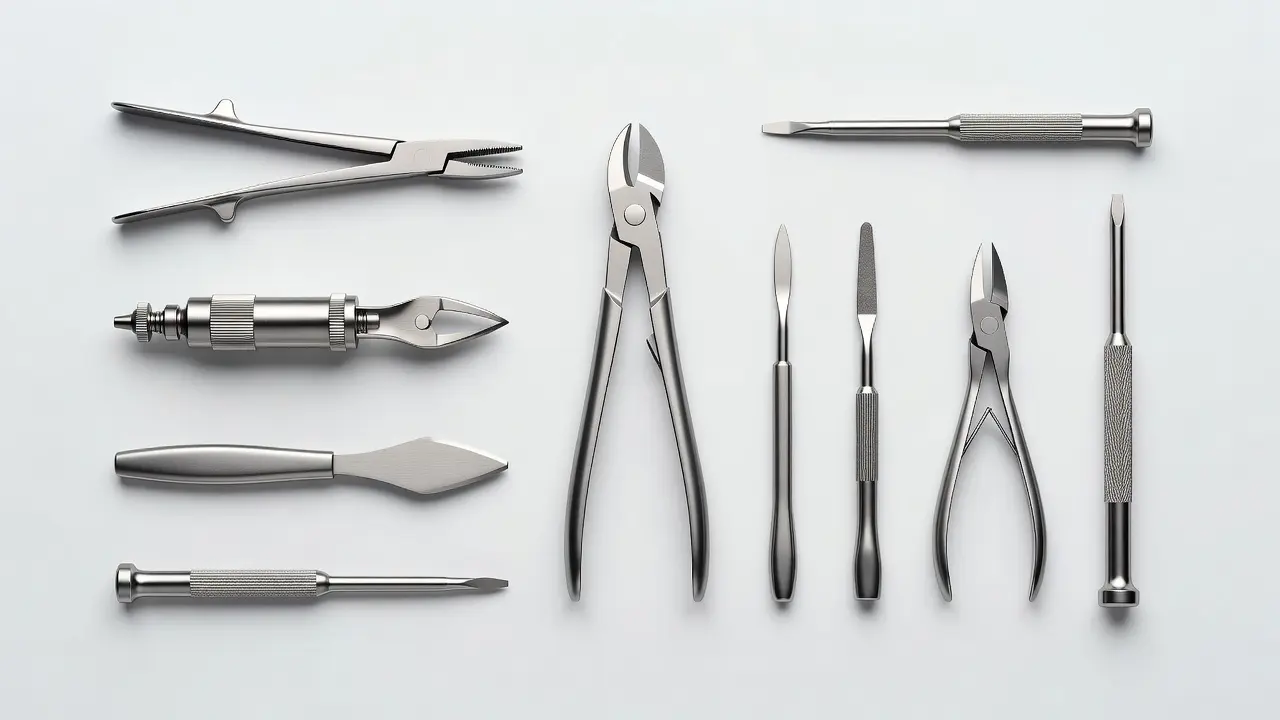
- Why Trauma Centres Can't Use a Regular Hospital's Buying Checklist
- Core Ortho Sets Every Trauma Centre Needs
- Material Matters: Stainless Steel vs. Titanium Instruments
- How to Vet Orthopaedic Instruments Manufacturers
- What Sets Vaishanav Surgicals Apart
- About Surgifact
- Applications
- Conclusion
A trauma centre is always open for business. Patients come in at 2 am with broken bones. Surgical tools must perform their function, without fail. This isn't something where there's leeway. No time to "figure it out" half way through the surgery.
That's why selecting the right orthopaedic instrument set is essential. It's not a matter of purchasing tools. It's a matter of entrusting those instruments with a life.
But how do busy trauma centres make a good choice? The first step is to get a good sense of Orthopaedic Instruments Manufacturers. Not all manufacturers produce for high pressure and high volume applications. There are a number of tools that are created for slow planned surgeries. Tools that are quick, powerful, and durable are needed for trauma.
It is also useful to choose your Orthopaedic Instruments Suppliers carefully, since the right one can make the difference between a fully stocked OT and a delayed surgery when every second counts.
Why Trauma Centres Can't Use a Regular Hospital's Buying Checklist
A regular OT plans its surgeries days in advance. It doesn't have that luxury at a trauma centre. Patients come unexpectedly. Surgeries take place at unusual times. It sometimes happens that three trauma cases arrive back-to-back.
This is a whole new world in the selection of instruments!
- Frequent Wear and Tear: A one-clinic practice may have one set which can last for weeks. A trauma centre is used several times a day. The wear is faster.
- Sterilisation Stress: The sterilisation cycles are more frequent. Stress on the instruments is higher, more frequently.
- Repetition Over Precision: It's important to have tools designed for repetition, not just slow precision. A scalpel that is good for a planned knee operation may not last even after the tenth sterilisation cycle in a single week.
Did You Know?
A regular hospital's instrument set might be sterilised a handful of times a month. In a busy trauma centre, the same set can go through several sterilisation cycles in a single day, which is why durability matters as much as sharpness.
Core Ortho Sets Every Trauma Centre Needs
All surgeries do not require the same equipment. You cannot use the same setup for a broken finger and a shattered hip. For this reason, there are various ready-to-use sets in the possession of trauma centres, depending on the type of injury.
- Trauma Basic Set: The “everyday” tools: scissors, forceps, retractors, clamps. This is what the surgeons go for whenever they get a fracture.
- Bone Holding Forceps Set: Used to securely hold bone fragments in place during surgery. Without it, correcting fractures becomes immensely difficult, even if they are simple.
- IM Nailing Set: When a long bone (thigh or shin) requires a rod through the middle, this is called IM nailing. This kit comes with nails, guide wires, and reamers to do that.
- External Fixator Set: External fixator pins and rods used to stabilize serious fractures, often prior to a larger surgery occurring at a later date.
- Small Fragment Set: Smaller plates and screws to fit more delicate bones like the wrist, ankle, and hand.
- Large Fragment Set: Larger plates/screws for larger bones such as the femur. Designed for extreme durability.
Did You Know?
IM nailing is one of the oldest trauma techniques still used today. The basic idea of inserting a rod through the centre of a long bone dates back over a century, yet it remains a first-choice method in trauma surgery because of how stable it keeps the bone during healing.
Material Matters: Stainless Steel vs. Titanium Instruments
Not all instruments are made the same way. The metal behind the tool changes everything — how long it lasts, how it feels in the surgeon's hand, and how well it survives constant sterilisation.
For trauma centres, this choice isn't just technical; it's practical. The wrong material wears out fast, and a worn-out tool slows down surgery.
| Feature | Stainless Steel | Titanium |
|---|---|---|
| Weight | Heavier, gives a solid feel | Much lighter, easier on the wrist during long surgeries |
| Strength | Strong, but can bend under repeated stress | Holds shape even after years of heavy use |
| Rust Resistance | Good, but can stain over time with frequent sterilization | Excellent, barely reacts to repeated autoclaving |
| Cost | Lower upfront cost | Higher upfront cost |
| Lifespan | Shorter lifespan under high-volume use | Lasts much longer, even with daily sterilization cycles |
| Best Suited For | Centres with moderate case volume | High-volume trauma centres with daily, repeated use |
| MRI Compatibility | Some grades may interfere with imaging | Naturally MRI-safe |
Did You Know?
Titanium isn't just lightweight — it's naturally biocompatible. Its surface forms a thin oxide layer that the human body rarely reacts to, which is why titanium is trusted not just for instruments, but for implants like plates, screws, and joint replacements too.
How to Vet Orthopaedic Instruments Manufacturers
Not all manufacturers are created equal. Many Orthopaedic Instruments Manufacturers are good at making slow and precise instruments
Don't sign any deal without asking the right questions:
- Check Certifications First: A reliable producer will have quality certifications, such as ISO and CE marking which are required for export. If they are unable to demonstrate these clearly, it's a red flag.
- Inquire About Batch Consistency: A sharp scalpel isn't worth very much if the next one is dull. Inquire about the testing procedures used for every batch — vague responses are likely to indicate that the quality control processes are not very strong.
- Look at Their Trauma-Specific Experience: A manufacturer producing mainly dental or cosmetic tools may not be aware of the stresses that occur in orthopaedic trauma. Inquire whether they make trauma sets on a regular basis, and whether hospitals such as yours are already using them.
- Evaluate After-Sales Support: Instruments break, parts wear out. The best manufacturer will provide repair services and have a swift replacement timeline in place if something does go wrong.
Did You Know?
Not all "ISO certified" claims mean the same thing. For surgical and orthopaedic instruments specifically, ISO 13485 is the standard that matters most, since it's built around medical device quality, not general manufacturing.
What Sets Vaishanav Surgicals Apart
Vaishanav Surgicals understands the demands of trauma centres more than anyone. As one of the leading Orthopaedic Instruments Suppliers, we do not just sell surgical instruments; we build a partnership by earning your trust on each and every order.
The way we procure our products is conservative and highly structured. We work only with trusted Orthopaedic Instruments Manufacturers, who follow the highest levels of manufacturing standards, so every set we deliver performs when it's needed most. We perform multiple quality checks on every order before it ever leaves our warehouse, and we also work closely with regional Orthopaedic Instruments Dealers and Orthopaedic Instruments Wholesalers, which helps us serve hospitals quickly, whether it's a single urgent set or a large bulk order.
We are aware that trauma happens without warning, so we guarantee our customers on-time delivery for every order, with no excuses when you need immediate replenishment, and our customer service representative team is available 24 hours a day, 7 days a week to assist you with any urgent needs.
About Surgifact
Surgifact / Vaishnav Surgical Co., is a world-renowned manufacturer and exporter of finely engineered surgical instruments. Founded by Mr. Sumeer Thukral in 1967, the company has carved a niche for itself by providing accurate, reliable and clinical medical instruments for close to 59 years. Operating from Jalandhar, Punjab, Surgifact serves a wide array of specialities within the medical sector—cardiology, orthopaedics, neurology, ENT, and dental instruments.
All instruments are produced from high-quality raw materials and fabricated to meet ISO, GMP, and CE standards so that each instrument stands for higher quality and performance. Today, institutions worldwide and distributors rely on the company's trusted and effective surgical solutions.
Applications
Orthopaedic instrument sets aren't built for just one use. The same tools come into play across many kinds of injuries and surgeries, day after day, in a trauma centre. Here's where these instruments are most commonly used:
- Fractures & Dislocations
- Arthroplasty & Osteotomy
- Amputations & Reconstructions
- Spondylolisthesis & Arthroscopy
- Debridement & Stabilization
- Realignment, Reduction, & Fixation
- Resection
Conclusion
Choosing the right orthopaedic instrument set isn't a small decision. It shapes how fast your team works, how safe your patients stay, and how smoothly your trauma centre runs every single day. From understanding the precise ortho sets instruments names to picking the right manufacturer, every step matters, and every choice carries weight when lives are on the line.
| Talk to Vaishanav Surgicals today, and let's build a supply chain you can trust before the next emergency walks through your door. |
The trauma basic set and IM nailing set see the highest use in trauma centres, simply because fractures are the most common injury type walking through the door. Surgeons reach for these first in nearly every case, which is why they're stocked in higher quantities than any other set.
The trauma basic set and IM nailing set see the highest use in trauma centres, simply because fractures are the most common injury type walking through the door. Surgeons reach for these first in nearly every case, which is why they're stocked in higher quantities than any other set.
Titanium holds up better under daily use and frequent autoclaving, making it ideal for centres with heavy patient flow. Stainless steel, however, remains a reliable and more affordable choice for centres with moderate case volumes. The right pick really depends on how often your instruments are used.
Yes, buy orthopaedic instruments online can be completely safe, but only if you're sourcing from a verified and certified supplier. Always check for proper documentation, after-sales support, and clear return or replacement policies before placing an order. Skipping this step is where most buyers run into trouble.
Never judge an instrument set purely by its upfront orthopaedic instrument set price. Always compare material quality, raw metal grades, certifications, and warranty terms first. A cheaper set that fails early often costs more in replacements and downtime than a slightly pricier, more reliable one.