

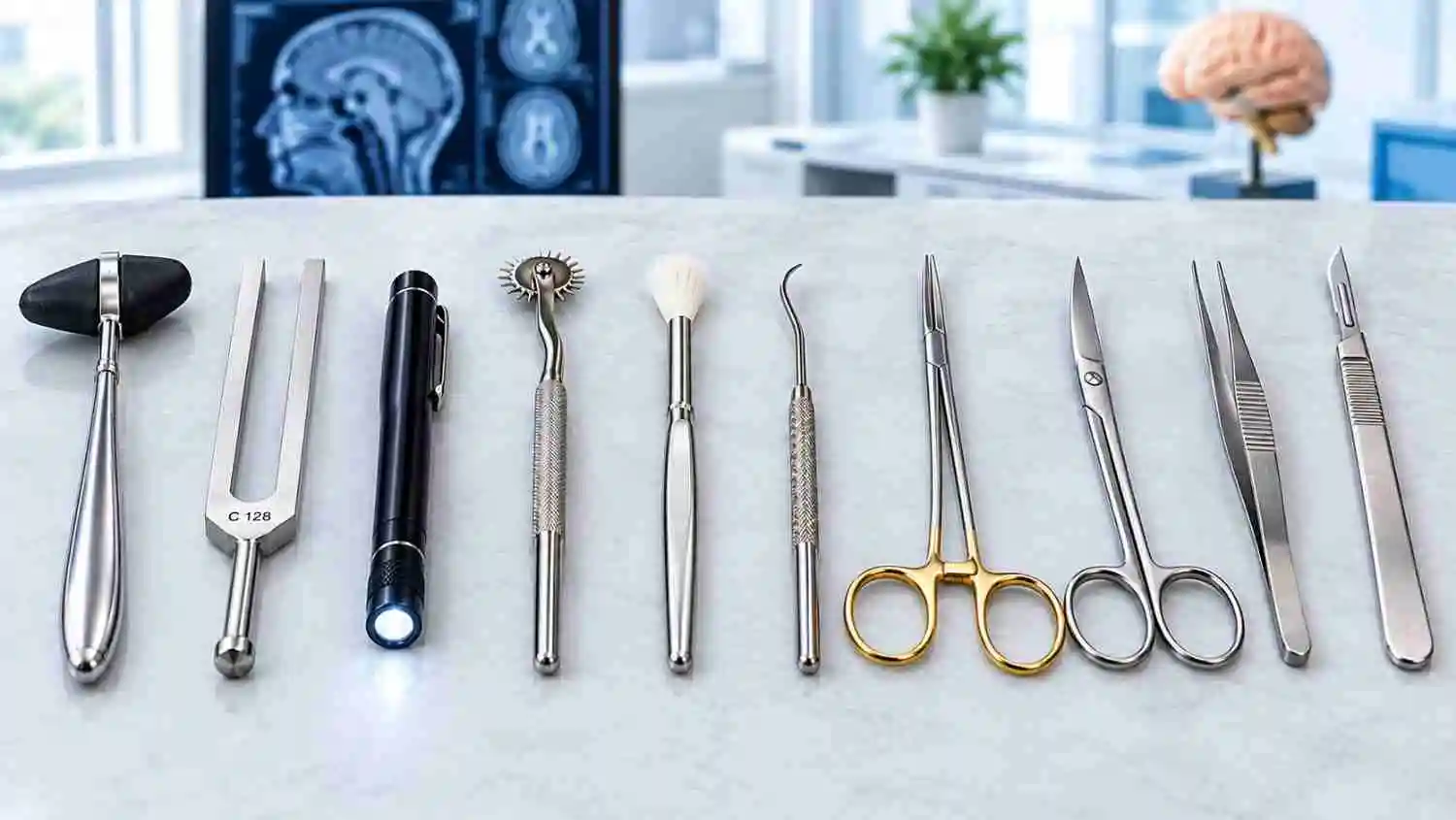
- What Are Neurology Instruments and Medical Equipment?
- Common Types of Neurology Instruments & Equipment
- Applications of Neurology Instruments in Healthcare
- Technical Specification
- How to Choose the Right Neurology Instruments
- Quality and Material Considerations for Neurology Instruments
- Key Features of Neurology Instruments
- Why Choose a Reliable Neurology Instruments Manufacturer?
- Conclusion
Neurology instruments are used in various parts of neurology such as neurological exams, therapies, investigations and in surgical operations. Instruments for neurologists aid accuracy and good practice; they are found in many hospitals, clinics and medical centers. Through the use of high-quality neurology equipment, neurologists can monitor symptoms and perform surgery more accurately.
What Are Neurology Instruments and Medical Equipment?
A neurology instrument is designed specifically to study, measure and/or treat a neurological disorder. The examination instruments enable neurologists to check reflexes, sensation responses, coordination and other functions, while surgical neurology instruments are precise, highly functional surgical tools.
Basic neurologists' examination instruments enable diagnosis in conventional practice while other neurology medical equipment could be for monitoring, therapy or diagnosis.
Historic Fact: “Neurological examination has evolved significantly over time. Early physicians relied mainly on physical observation, reflex testing, and sensory assessment to understand nervous-system disorders. The development of specialized examination tools and surgical instruments gradually improved the ability of healthcare professionals to evaluate neurological conditions and perform increasingly precise procedures.”
Common Types of Neurology Instruments & Equipment
Types of neurology instruments can be further categorized as diagnostic tools for examination, and diagnostic & surgical tools. Neurology equipment is used in neurological examination, monitoring, diagnosing, treating, and some specific procedures.
| Type | Common Examples | Main Use |
|---|---|---|
| Examination Instruments | Reflex hammers, tuning forks | Neurological assessment |
| Diagnostic Equipment | Nerve assessment and monitoring devices | Diagnosis and evaluation |
| Surgical Instruments | Forceps, retractors, scissors | Neurosurgical procedures |
| Sensory Testing Tools | Sensory testing instruments | Nerve and sensory assessment |
Neurological Examination Instruments
Tools such as penlights, tuning forks, reflex hammers, and sensory testing devices are part of a basic neurological examination instruments set. In routine patient examinations, neurologists use these examination tools and other neurology instruments focused devices to determine such things as reflexes, sensations, eye pupils, and muscle tone.
Neurology Surgical Instruments
Neurology surgical instruments consist of such tools as forceps, retractors, scissors and others to delicately and safely manipulate the various parts of the brain. This allows neurosurgical instruments to aid surgeons during surgical processes. Neurosurgical instruments can help expose the tissue that needs to be worked on as well as assist the surgeon with stabilization of procedures.
Diagnostic and Supporting Neurology Equipment
Neurology equipment used in hospitals and neurological departments helps professionals and practitioners to diagnose patients, monitor and assess patient condition and management. Neurology diagnostic equipment can assist healthcare practitioners in assessing neurological function and clinical diagnosis. Equipment selection varies according to procedures required, examination and assessment needs and clinical setting.
Case Study
It was a requirement by the procurement section of a multi-specialty hospital that the neurology section should have a stable instrument catalog. The comparison was made based on material strength, accuracy, ergonomically, sterilization compatibility and their function. By performing this comparative study, the examination and surgery instruments were chosen with adequate accuracy according to department demand.
Applications of Neurology Instruments in Healthcare
Recognizing these applications clearly demonstrates how neurology instruments uses throughout each phase of care: examination, operation and monitoring.
- Neurological Examination: Instruments aid the examination of reflexes, sensation, coordination and other neural functions.
- Operations: Specialized instruments facilitate accurate manipulation during neurosurgery.
- Nerve Assessment: Some neurological instruments assist practitioners in the examination of nerve responses.
- Patient Assessment: The neurological equipment also contributes towards examination during regular patient evaluation and the logging of neurological details.
- Treatment: A hospital they are also employed to aid examination, measurement and treatment.
Technical Specification
The following table talks about the technical specification of neurology instruments.
| Specification | Details |
|---|---|
| Instrument Category | Neurological examination and surgical instruments |
| Primary Application | Examination, diagnosis, and surgical procedures |
| Material | Suitable surgical-grade material, as applicable |
| Finish | Smooth and suitable for clinical handling |
| Instrument Type | Examination and procedure-specific options |
| Sterilization | Based on the instrument and recommended method |
| Usage | Healthcare facilities, hospitals, and clinics |
| Quality Focus | Precision, durability, and consistent manufacturing |
| Customization | According to product and buyer requirements |
| Supply | Suitable options for institutional and bulk procurement |
How to Choose the Right Neurology Instruments
Common question- how to choose neurology instruments? By considering all these factors in detail, buyers are sure to choose the right neurology instruments suited for clinical practice and to promote a secure, economic, yet trustworthy neurology facility. This neurology equipment buying guide helps to purchase the best neurology instruments.
- Application- Are the instruments for general neurological diagnosis, nerve studies or surgery?
- Precision- Choose instruments to enable control in hand and the precise evaluation of clinical states.
- Ergonomics- Balance, weight and grip of the handle. Does it allow comfortable handling during frequent application?
- Material- The suitable material in strength and in application-in accordance with the planned procedures.
- Durability- The instruments ought to survive normal frequent use and appropriate management.
- Sterilization- Proper cleaning and sterilization procedures need to be ensured to meet hospital requirements.
- Compatibility- Confirm that it fulfills your hospital's equipment buying guide needs.
Myth: “Neurology instruments are used only during neurological surgeries.
Fact: Neurology instruments have applications beyond surgery. Basic examination tools can support reflex, sensory, and neurological assessments, while specialized equipment may assist with diagnosis, monitoring, and treatment. The appropriate instrument depends on the clinical procedure and requirements of the healthcare facility.”
Quality and Material Considerations for Neurology Instruments
High quality neurology instruments shall be made with surgical quality materials that are shatter resistant and that will continue to be durable, strength and suitability in the surgical environment in neurology. Chemical resistance or other naturally smooth finishes can make for easy cleaning and handling. Accurately made neurological instruments provide a predictable outcome in surgery.
Those that can be reused should also be examined for uniform design and materials which meet the parameters required to establish reliable cleaning and sterilization processes. These factors allow the development of surgical instruments quality with adequate characteristics, enabling the health centers to choose the quality of the tools used in neurological care.
Key Features of Neurology Instruments
Instruments used in neurology should assist with the practice of precision, control and applicability within a clinical environment. Factors for the design of neurology instrumentation include:
- Accuracy: Accuracy of examination and of controlled handling while conducting procedures.
- Ergonomic Construction: Ergonomic handling of instruments during repetitive or lengthy procedures.
- Sturdiness: Application of robust materials which can withstand repetition.
- Smooth Surface: Facilitate a thorough cleaning and sterilization.
- Sterilization Capabilities: Reusable instrument capable of withstanding recommended sterilization techniques.
- Usefulness for its application: Neurology instrumentation may require variations depending upon its role in examination, diagnostics or surgery.
- Consistency: Instruments should all be constructed to an identical standard.
Why Choose a Reliable Neurology Instruments Manufacturer?
The purchase decision of neurology instruments manufacturer like Surgifact for the hospitals, distributors, and bulk purchase parties, they can refer to aspects of manufacturing quality, products available, the inspection procedures, stability of product quality, customizable choice, and stock keeping ability.
A trusted company that is a neurology equipment supplier must be able to answer every procurement needs. You are suggested to visit Surgifact neurology product list to compare for suitable instrument type according to the available range of products.
Conclusion
Accurate, long-lasting and task-specific neurology instruments are critical to rendering good neurological services. Before acquiring neurology medical equipment, prospective buyers are to inspect and evaluate the quality of products, user convenience and specification fitting for surgical procedures required. A trustworthy manufacturer like Surgifact can guarantee clinical and purchasing demands of the institution.
They include examination tools, diagnostic devices, and surgical instruments.
They support neurological examination, nerve assessment, diagnosis, surgery, and patient care.
Surgical-grade materials with suitable durability, finishing, and sterilization compatibility are commonly preferred.
Evaluate application, precision, ergonomics, material quality, durability, and supply capability.
While buying neurology equipment hospitals should assess compatibility, sterilization requirements, quality standards, and procurement needs.
Yes, buyers can explore Surgifact’s product range to identify instruments suited to their healthcare requirements.